
ARTICLE

Person's hand on a tree in a nature listening practice

September 24, 2026

Add to favorites

Nature Listening: How to Know You’re Not Just Imagining It

Learn how to practice nature listening, connect with trees, and tell the difference between intuitive perception and imagination.

By Basia Alexander

What makes intuitive nature listening possible? Of course, it’s your open heart and open mindedness. But many people worry they are not receiving actual information from a tree, plant, or other nature being, and are just imagining it or making it up.

Nature listening is the practice of quieting yourself enough to perceive and receive information from trees, plants, and other living beings.

How can you tell the difference? Here’s the quick answer, and then I’ll tell you the key distinction that comes from my tree-friend, TreLanYa, a wise old coastal live oak in California.  

What Makes Nature Listening Possible?

Preparing yourself for an encounter with a tree begins with observation, appreciation, and finding inner quiet. Those are the first three of my Five Easy Steps for Connecting. Then, it helps to know some new sciences: your bioenergy field and consciousness can overlap with the bioenergy field and consciousness of a tree. It’s like drops in a pond that overlap. That way, information is shared and exchanged.

Start your nature listening with simple questions that are verifiable. 

3 Questions to Ask to Begin Listening to a Tree

(1) How Old Are You?

Use a yes/no question-and-answer process either intuitively or with a pendulum, or kinesiology to narrow down a number. Then, you can check the probable age with the property owner or land records. However, some trees have a sense of humor and don’t want to admit to being more than 49 years old. Others will tell you how young they feel inside.  

(2) Can You Show Me a Scene From Your Life?

Allow imagery or feelings to occur in your mind or body. In a New Jersey churchyard, I communed with a very old oak. It showed me uniformed troops having lunch under its branches. I checked. Before the church was there, the tree was known to have been in an area where Washington’s armies were stationed.  

(3) Tell Me About Where You Live

Again, allow imagery, feelings, or words to come to you. My sense of inner hearing is strong so when I first met my tree-friend, TreLanYa, I received words which I wrote down about its personal history and its location. TreLanYa told me that it was planted with the hope for peace by a Native American chief more than 350 years ago right over a small stream which has sustained it. When I checked with the property owner, it was true.  She explained that there are springs and tiny underground streams all over that geographic area.  

So whatever doubt you may have, such as, “Am I making this up?” can be easily dispelled.  
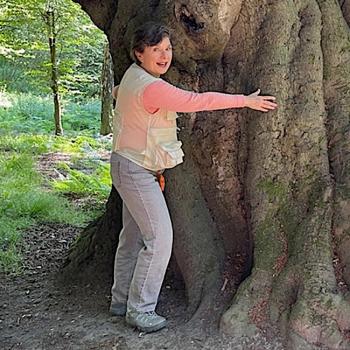
The more honest you can be with yourself, the greater your confidence in your perceptions.
Basia Alexander

But what about when you seek deeper communion or profound information?  

Nature Listening: Imagination or Perception?

According to TreLanYa, here’s the key distinction that fuels nature listening and tree whispering: it has to do with the quality of your personal experience. Essentially, imagination comes from within and is human-centric while perception comes through the senses and through heart-centered emotions. Perception is usually sourced from a kind of curiosity about another living being. We explain, illuminate, give examples, and lead practices about this difference in our nature listening and tree whispering workshops so students can overcome any inner doubts and attain a higher state of confidence in themselves.  

But for now, let me ask you a few important questions.

Can You Listen Without an Agenda?

(1) Can you be neutral?  

When you connect with any other living being, can you recognize in yourself whether you have some preference, some desire, some hidden fear or even an intent about either yourself or that living being?  

(2) Can you come from the tree’s point of view?

In other words, can you simply feel yourself (metaphorically) “seeing” through the tree’s eyes, “standing” in its roots, and “being” the tree?  

(3) Can you call yourself that tree’s partner? 

True partnership with another usually includes mutuality, not self-centeredness. If you are a partner, you probably have a concern for the other’s well-being and ask questions like, “How are you, really?”  

What Does It Mean to Partner With a Tree?

Trees are the most generous of beings and wise beyond measure. Trees’ consciousness or spirit is a beacon of both beneficial personal and universal information. However, a tree has its own life, its own goals, its own purposes, and wants to share those with you as well as offer insight into your own life. 

Trusting What You Receive From Nature

The more honest you can be with yourself, the greater your confidence in your perceptions. That means less concern about “making it up.” And it follows that the information and feelings you perceive and receive from that tree or nature being will be more and more accurate, insightful, deeper, and true.