ARTICLE

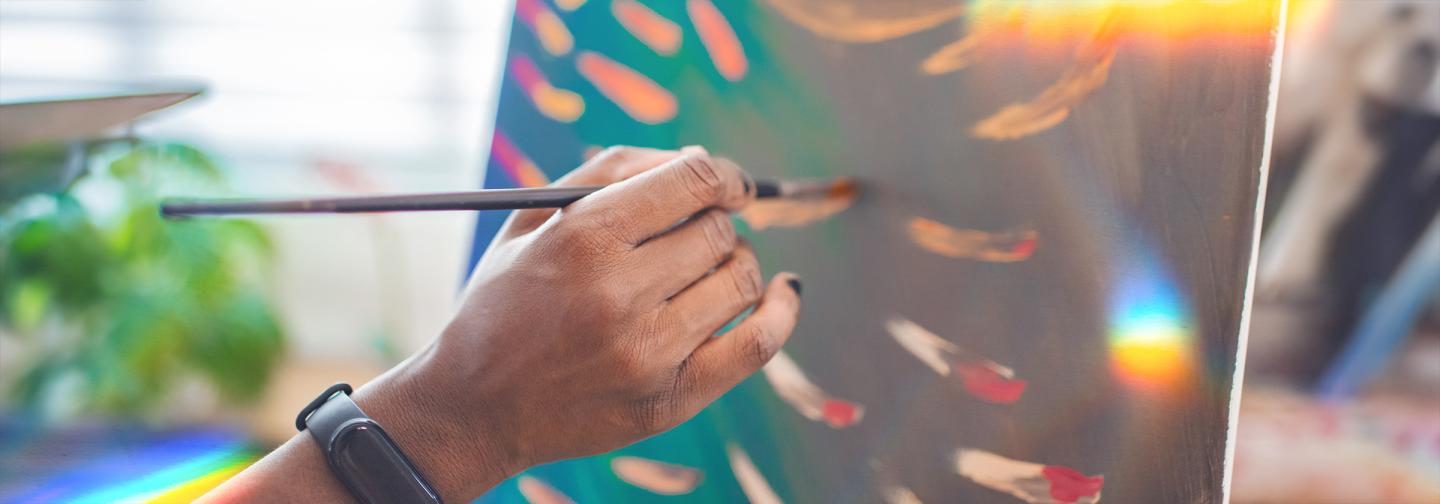
Close-up of a person painting abstract art on canvas, illustrating creativity and mental well-being

April 13, 2026

Add to favorites

Can Art Improve Your Well-Being? A Psychic Medium on the Healing Power of Creativity

Best-selling author Laura Lynne Jackson explores how art and creativity support mental health, intuition, and overall well-being.

By Laura Lynne Jackson

As you’ve seen, I’ve included some poems in these pages, because I love poetry and I think it’s uniquely moving and inspiring. Here are a few lines from the poem “High Tide” by one of my favorite poets, Christine Osvald-Mruz (who also happens to be my sister):

Against a distant cliff, a tiny sailboat wafts.
Seagulls drift.
Near the shore, a small wave rises.

How Art Improves Mental & Physical Health

Okay, now that you’ve read it, I want you to know that you have just improved your mental and physical health.

We spoke about how honoring our connection to nature can benefit us in meaningful ways. The same is true of art. Scientific studies have established a strong connection between creating and enjoying art and our overall wellness as humans, and as a result, healthcare providers are incorporating the arts into their treatments. According to the World Health Organization, “Including the arts in health care delivery has been shown to support positive clinical outcomes for patients ... Benefits are seen across several markers, including health promotion, the management of health conditions and illness, and disease prevention.” 

The Science Behind Art, Healing & Well-Being

Imagine that! Simply enjoying works of art—going to a concert, visiting a museum, reading poetry—alters our brain in a way that is extremely beneficial to us and to the world as a whole. But how can merely gazing at the Mona Lisa make us healthier? Exposure to the arts, or “art intervention,” as some scientists call it, “showed more functional connectivity in the frontal and parietal brain cortices,” determined a study published in the Public Library of Science journal PLOS. “This correlated with increased psychological/stress resistance ... and demonstrated the neural effects of visual art production on psychological resilience in adulthood.” 

Simply put, art is good for us.

Art as Medicine: A Timeless Tool for Healing

This, of course, is neither news, nor new. “For thousands of years, people have been using arts like singing, painting and dancing for healing purposes,” declares the Mayo Clinic. “Modern healthcare settings continue to use art to help treat specific conditions, contribute to overall well­being and even help prevent diseases.” Many of us integrate art into our lives instinctively and sometimes without even realizing it—we doodle on a margin to relieve stress, or we sing in the shower to unwind. To live a life free of art, even if you don’t think of yourself as an artistic person, is to deprive yourself of an enormous stream of resources that can enrich your life.

Why You Don’t Have to Be an Artist to Benefit From Creativity

One way to tap into that stream is to be an artist yourself. I’m not talking about becoming a professional artist, though if that is your calling, then by all means you should heed it. I’m talking about creating a work of art that comes from your heart.

Perhaps you’ve tried to paint a landscape, or sculpt clay, or write a short story, and the results have dismayed you enough to make you quit. But producing something great is not the point of making art.

The act of creating—letting that art flow through you—leads you on a path of connection and illumination. Because the Other Side has shown me that no artist ever works alone. We are connected to a Team of Light that works through and with us, and in turn we shine brighter because of them. Art is an expression of this guided act of creation.
Enjoying art is not a passive thing. It engages us mentally, spiritually, emotionally, and, yes, biologically.
Laura Lynne Jackson

The True Purpose of Art: Joy, Growth & Self-Expression

There is a story I found on the internet that is usually attributed to the writer Kurt Vonnegut and that is, whoever it comes from, a beautiful, timeless lesson for us all:

When I was 15, I spent a month working on an archeological dig. I was talking to one of the archeologists one day during our lunch break and he asked those kinds of “getting to know you” questions you ask young people: Do you play sports? What’s your favorite subject? And I told him, no I don’t play any sports. I do theater, I’m in choir, I play the violin and piano, I used to take art classes.

And he went WOW. That’s amazing! And I said, “Oh no, but I’m not any good at ANY of them.”

And he said something then that I will never forget and which absolutely blew my mind because no one had ever said anything like it to me before: “I don’t think being good at things is the point of doing them. I think you’ve got all these wonderful experiences with different skills, and that all teaches you things and makes you an interesting person, no matter how well you do them.”

And that honestly changed my life. Because I went from a failure, someone who hadn’t been talented enough at anything to excel, to someone who did things because I enjoyed them. I had been raised in such an achievement­-oriented environment, so inundated with the myth of Talent, that I thought it was only worth doing things if you could “Win” at them.

How Art Improves Empathy, Mood & Cognitive Function

The point of art is the pleasure and joy it brings us, either through creating it or simply by exposing ourselves to it. Attending an artistic event is just as beneficial as sitting down to create art. These benefits are so well documented that Penn State University began a medical humanities program that requires medical students to take a class such as Impressionism and the Art of Communication in their fourth year. At Yale and Harvard, medical students need to visit museums and write reports describing the works of art they saw in detail. Studies have found that art improves critical thinking and empathy, builds bias awareness, and eases pain and depression—all of which explains why the world’s top universities and colleges have integrated art into a variety of disciplines. Meanwhile, the American Congress of Rehabilitation Medicine says that just observing art can:

  • Increase serotonin levels (which positively affects mood and emotion)
  • Increase blood flow to the part of the brain associated with pleasure
  • Foster new ways of thinking
  • Help you to imagine a more hopeful future

The Power of Shared Art Experiences & Human Connection

We can introduce these benefits into our lives by bringing art into our paths. The art we choose to enjoy doesn’t matter—it can be dance, music, poetry, drama, sculpture, paintings, performance art, and on and on. London’s Global University did a study that found that just sitting in a theater with other theatergoers and watching a show not only affects you emotionally through the performance but brings you the pleasure of being in an audience atmosphere, where everyone is connected by the performance.

This connection to your fellow theatergoers is not just conjecture. The LGU researchers monitored the heart rates and electrodermal activity of 12 audience members enjoying a live performance of the musical Dreamgirls. To their surprise, they discovered that the theatergoers’ hearts were beating in unison, and their pulses were slowing down and speeding up at the same rate.

Watching a show synchronized everyone’s heartbeat! What an astonishing display of the power of art in our lives. The same researchers earlier discovered that watching a live theatrical performance has the same stimulative benefit as performing 28 minutes of cardiovascular activity.

How Art Engages the Mind, Body & Spirit

Enjoying art is not a passive thing. It engages us mentally, spiritually, emotionally, and, yes, biologically. (This truth is explored more in the book Your Brain on Art, by Susan Magsamen and Ivy Ross, which I highly recommend.) The pure and absolute beauty of a perfectly crafted note of music, or of a sublime brushstroke across a canvas, or of the simple stringing together of 13 words (as in the poem that opens this chapter) can reconnect us to our humanity, open our eyes to the splendor and magic of existence, make us feel more vital and alive, and illuminate our paths through life.

The message, then, is to invest in creativity—to bring art into your journey. That investment doesn’t have to be massive or even time­consuming. You can begin by picking up an artistic hobby—journaling, sketching, collaging—and working on it for a few minutes a day. Or you can go bigger and join a local chorus or theater group. Or buy a canvas and some paint and indulge your imagination. What’s clear is that opening your eyes and mind to your own creativity, and to the creativity of those around you, is a deeply meaningful and beneficial way to honor your connection to the world. It is a way of connecting to something that is greater than yourself—and to the great swirl of collective energy.

So maybe instead of “an apple a day,” you can try “a poem a day.” The payoff, I promise you, will be worth it.

Adapted from the book Guided: The Secret Path to an Illuminated Life. Copyright © 2025 by Laura Lynne Jackson. Reprinted by arrangement with Penguin Random House LLC. All rights reserved.