When these slower-moving planets relate in the heavens, they correspond to significant events on Earth. For example, in 2020, Saturn and Pluto conjoined in January, which coincided with a global pandemic. Coincidentally, the geodetic map, an astrological locality tool, shows those two planetary lines culminating directly over Wuhan, China, in 2020, where the first cases of Covid-19 were reported. As in this example, these alignments can coincide with an event that sparks a global shift in consciousness, but they can also indicate an emergence of a new paradigm without a specific inciting incident.
Many astrologers live by the Hermetic phrase "as above, so below." As is the microcosm, so is the macrocosm. Carl Jung connected this to synchronicity. “When significant astrological alignments happen, like the ones in July, we can draw from those symbols to inspire our imagination for what’s possible in our world,” Lang says.
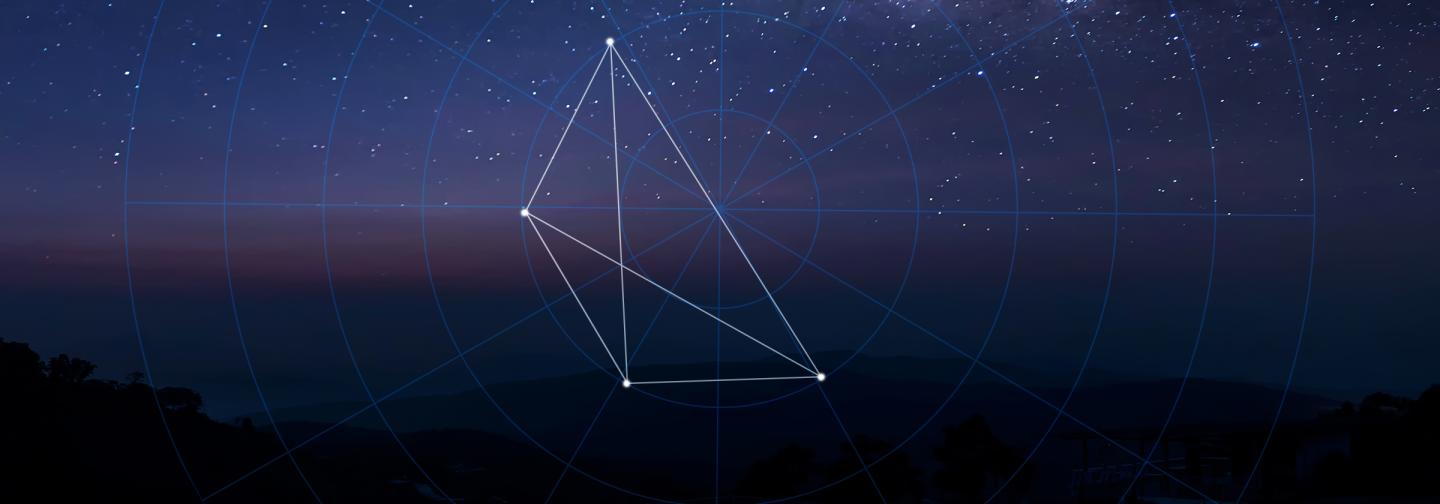
The Barbault Basket features a dynamic opposition between Jupiter in Leo and Pluto in Aquarius, with harmonizing trines and sextiles to Uranus in Gemini and Neptune in Aries. Each of these planets will be between 4˚-5˚ of their respective signs, which is a near-exact geometric relationship. Those exact aspects make this alignment so rare.
Lang says, “When viewed together in this configuration, these planets look like a basket or a cradle. It’s as if we’re nurturing–cradling–something new. The opposition between Jupiter and Pluto can be associated with big dreams and big ideas. It suggests an urge to take a leap of faith. The trine between Uranus and Pluto shows a harmonizing of the revolutionary activities in the mid-1960s when Uranus and Pluto conjoined. Here, we see a strategic, problem-solving phase of the revolution. The Barbault Basket shows innovation. It suggests we’re not going back to the way things were before, and the seeds we plant now will harvest for generations to come.”
Does Astrology Predict Events—or Reveal Patterns?
One of the most common misconceptions about astrology is that it promises certainty.
In reality, many modern astrologers describe astrology less as a tool for prediction than as a language of symbolism. Instead of declaring exactly what will happen, astrology explores how different energies, themes, and cycles may unfold.
Think of it less like reading tomorrow's headlines and more like reading the seasons.
A weather forecast might suggest conditions are favorable for rain, but it can't predict every raindrop. Likewise, an astrological chart may indicate periods associated with growth, challenge, creativity, or transition, while leaving room for individual choices and circumstances.
This perspective shifts the conversation from prediction to participation.
Fate and Free Will: An Ancient Question
The tension between destiny and choice has fascinated philosophers, spiritual traditions, and astrologers for thousands of years.
If everything is predetermined, what role do our decisions play?
If everything is entirely within our control, why do certain moments in life feel strangely timed or deeply meaningful?
Astrology offers one way of exploring these questions. Rather than viewing fate and free will as opposites, many practitioners see them as partners. A birth chart may suggest recurring themes, natural strengths, or significant turning points, but how a person responds to those moments remains an act of choice.
In this way, astrology becomes less about surrendering to destiny and more about engaging with it consciously.
Why Rare Planetary Alignments Matter
The fascination surrounding the Barbault Basket isn't simply about the planets themselves. It's about the awe and reverence we feel when we consider our intimate connection with the natural rhythms of the cosmos. Ultimately, all planetary cycles are Earth cycles because astrologers typically employ a geocentric framework. All planetary alignments are geometrically oriented to our home planet. In the pages of this site, you’ll read faculty members and spiritual teachers inviting us to be present. Rare planetary alignments offer us the same invitation. They ask us to be aware, pause, and reflect on the bigger questions of our lives.
Throughout history, eclipses, planetary conjunctions, and other astronomical phenomena have inspired rituals, storytelling, artistic expression, and spiritual inquiry across cultures. “Astrology shows us where we are at any given moment within an infinite timeline of cosmic motion. It can help us locate ourselves right here and now within an evolving world, and that reflection helps us make meaning of the present moment.” Lang says.
Whether viewed through an astrological lens or simply appreciated as remarkable events in the sky, these moments remind us that change is part of every human life.
They encourage us to ask:
- Where am I being invited to grow?
- What chapter is coming to an end?
- What possibilities am I ready to embrace?
- How can I move forward with greater intention?
These are meaningful questions at any time in life, but reading about significant planetary alignments may inspire deeper reflection.
Astrology as a Practice of Reflection
For millennia, humans have associated myths and stories with the movements of the planets. Perhaps meaning-making is astrology's enduring appeal and not prediction.
By encouraging reflection, self-awareness, and curiosity, astrology provides a framework for exploring life's rhythms rather than trying to escape uncertainty.
The Barbault Basket may eventually pass from the headlines, but the questions it raises will remain.
Can we recognize moments of transformation when they arrive?
Can we approach change with greater awareness instead of fear?
And can we hold space for both destiny and choice—honoring the patterns we inherit while remembering that every day presents an opportunity to write the next chapter of our own story?