
ARTICLE

People stacking hands in teamwork circle, representing human-centered leadership and collaboration

April 15, 2026

Add to favorites

The Future of Leadership: Mindfulness, Ethics & Human-Centered Leadership

What is the future of leadership? Discover how mindfulness, ethics, and human-centered leadership can help leaders navigate change and reduce division.

By Anu Gupta

As we move deeper into the 21st century, we find ourselves in a time of profound uncertainty.

War and geopolitical instability. Deepening political and social division. A constant stream of information and distraction. Rapid technological change that is reshaping how we live, work, and relate to one another. For many, there is a persistent sense of disorientation, of ground shifting beneath our feet.

And in the midst of all these shifts, leadership matters more than ever.

But the models of leadership we have inherited were designed for a different era. Twentieth-century leadership emphasized control, efficiency, hierarchy, and output. It was built for industrial systems where predictability and standardization were prized. That model is no longer sufficient.

The challenges we face today are not just technical—they are emotional, relational, and rooted in how we perceive ourselves and one another. To meet this moment, we are being asked to upgrade not only our strategies, but our consciousness.

In this new era, I believe leadership rests on four essential capacities: reclaiming our attention, cultivating ethical integrity, remembering our shared humanity, and continuously acting as bridge builders across differences.

1. Mindful Leadership: Reclaiming Attention in an Age of Distraction

One of the defining challenges of our time is not only what we face, but what we pay attention to. Our attention is constantly being pulled outward, toward urgency, outrage, fear, and distraction. It is being monetized, fragmented, and shaped in ways that often move us further from clarity and connection.

To lead well in this environment, we must begin by reclaiming our attention.

This means intentionally building within our daily routines time and space to turn inward in order to reclaim our attention, i.e., learning to know ourselves, to observe our thoughts, somatic experiences, and emotions, and to ground in something deeper than the noise of the external world. This is not withdrawal; it is a return to the source of wise action.

In these times, a daily contemplative practice—whether meditation, breathwork, mindful movement, or reflection—is essential to transcend the noise and to remember daily who we are and what we stand for.  In addition, these practices train the mind, regulate the nervous system, and remind us of a deeper truth: that beneath our roles and identities, we are interconnected beings.

Without this grounding, we are easily swept into reactivity. With it, we cultivate presence, wisdom, and clarity.

2. Ethical Leadership: Aligning Values With Action

If reclaiming attention is the foundation, ethical integrity is the compass.

Across cultures and traditions, we find a shared set of guiding principles for how to live and lead. The Five Precepts in Buddhism. The Yamas and Niyamas in Hindu philosophy. The Ten Commandments in the Abrahamic traditions. While they differ in form, they point toward universal virtues of non-harming, truthfulness, restraint, generosity, and care.

There is a reason why our ancestors across cultures and geographies agreed upon these principles. To me, they are not rigid rules, but practices that are called to be lived through our daily thoughts, words, and actions. They help align our actions with our values, especially in times of uncertainty and pressure.

Leadership in the 21st century requires a deep commitment to these principles—not as performance, but as practice. We may not always get it right. We may make mistakes. But the work is to notice, to take responsibility, to learn, and to realign.

This is not about self-judgment or perfection. Rather, it is about purification of our hearts and minds, and continually refining how we show up so that our actions reflect our deepest intentions. In this way, we lead not just through what we say, but through who we are.
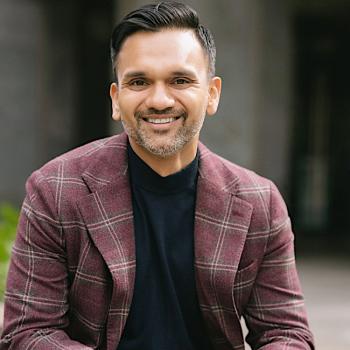

In an age of polarization and misinformation, one of the most important roles of a leader is to be a bridge builder.
Anu Gupta

3. Human-Centered Leadership: Why Our Shared Humanity Matters

At the heart of so much division in our communities and world today is a forgetting.

We forget that before all labels, we are human beings. We are Homo sapiens, 99.9 percent genetically identical. And yet, we organize our world around differences—race, gender, religion, nationality, ethnicity—treating them as if they define our worth and determine our belonging.

These identities do matter as they shape our lived experiences. But they are secondary to a deeper truth: our shared humanity.

Much of my work over the past two decades—through my social enterprise, in law, scholarship, and teaching—has been rooted in helping people remember this very essential truth. Because when we lose sight of our shared humanity, it becomes easier to dehumanize, to divide, and to harm.

His Holiness the Dalai Lama often reminds us, “We are all the same as human beings, we all want to lead a happy life.” This simple truth carries profound implications. It invites us to look beyond the stories of separation and to reconnect with our fundamental interdependence.

Leadership today requires this remembering. It requires the ability to hold both difference and unity—to honor lived experience while not losing sight of what connects us all.

4. Bridge-Building Leadership: Leading Across Division & Difference

In an age of polarization and misinformation, one of the most important roles of a leader is to be a bridge builder

The narratives of our time are filled with distortions about who belongs, who is worthy, and who is “other.” These misperceptions are reinforced by systems, amplified by media, and internalized in ways that shape how we see and treat one another.

Leadership, then, is not just about decision-making, it is about translation.

It is about helping people see more clearly. Correcting false narratives. Creating spaces where different perspectives can be heard and understood. Bringing people together across lines of difference. This work begins internally.

In my work, I offer somatically informed contemplative tools like PRISM—Perspective Taking, Prosocial Behavior, Individuation, Stereotype Replacement, and Mindfulness—to help individuals interrupt patterns of nervous system dysregulation, fear, and reactivity. These capacities allow us to see others more fully, respond with care, and act in ways that build connection rather than division.

But we can only do externally what we are willing to practice internally. Bridge building, then, is not just a strategy—it is a way of being that naturally emerges when we reclaim our attention, live with ethical integrity, and remember our shared humanity.

Soul-Force Leadership: A New Model for the Future of Leadership

The challenges of our time are not only asking us to change what we do—they are inviting us to transform who we are.

Philosopher Grace Lee Boggs captured this beautifully:

“People think of revolutions in terms of taking state power, but we’ve had revolutions and we’ve seen how the states which they have created have turned out to be like replicas of the states which they opposed.

“We have to bring two words together: recognize that we are responsible for the evolution of the human species. It’s a question of two-sided transformation and not just the oppressed versus the oppressor. We must change ourselves in order to change the world.”

As leaders, we are being called to plant new seeds of consciousness—ones rooted in inclusion, understanding, and compassion. To move beyond models of domination and toward ways of leading that foster belonging and collective flourishing.

And to do this, we must begin with ourselves.

The good news is that we do not have to invent an entirely new path. We can draw from the wisdom of those who came before us—our ancestors and teachers—who have long pointed toward these same truths.

Reclaiming our attention. Living with ethical integrity. Remembering our shared humanity. And building bridges across differences. These are not just ideas, they are practices. And through them, we can begin to build a world where all belong—and all have enough to thrive.